askWheat for breeders: worked examples
askWheat answers the gene and germplasm questions that come up between a QTL result and a crossing block: which allele does a line carry, where can I get a donor, which marker tags it, which gene sits under my peak, and which mutant lines would test it. It joins the IWGSC reference, the Watkins landrace collection (pangenome, WatSeq SNPs, field trials), CropSNPdb genotypes of Australian cultivars, OzWheat GWAS, Cadenza and Kronos EMS mutants, expression atlases and genebank records, and links every answer to its source.
| Breeding question | Where to start | Example |
|---|---|---|
| Which alleles of my target gene exist, and in which lines? | Gene page, Haplotypes tab | 1. Rht-B1 |
| Which gene underlies a GWAS hit, and what marker tags it? | Trait map, gene page | 2. Height on 4D |
| Are two parents different at my region? | AI assistant (CropSNPdb tools) | 3. Scepter vs Mace |
| Who carries a resistance allele? | Gene page, Haplotypes tab | 4. Lr34 |
| Which genes under my QTL are worth following? | Gene finder, gene pages | 5. NB-ARC on 2B |
| Can I knock the gene out to test it? | Knockout screen | 6. Rht-B1, TaGW2, Lr34 |
How to use these examples
There are two ways in. The web pages need no account. The MCP server (https://askwheat.plantdatabases.org/mcp) plugs askWheat into an AI assistant such as Claude as a custom connector, so questions can be asked in plain language and answered with tables, charts and maps; ai.html shows how to connect and lists every tool.
Each example has the web route and a Try it box: the prompt to type into an AI assistant with askWheat connected, the tools the assistant calls, an excerpt of what comes back (real askWheat output, November 2026), and what to take from it. Copy a prompt, run it, then change the gene, trait or line to your own.
- Name the gene by symbol or any IWGSC ID; askWheat converts between RefSeq v1.0, v1.1 and v2.1.
- Say what you want back (a table, a map, a box plot) and ask for sources; the assistant draws charts from the returned numbers.
- Ask follow-ups in the same conversation ("now only the AG5 lines", "add Seedstor links"); the assistant keeps the earlier results.
1. Allele mining for a target gene (Rht-B1)
The Rht-B1 Haplotypes tab groups 1,047 Watkins landraces and modern lines into SNP haplotypes from 33 WatSeq SNPs in the gene ±2 kb, shows their frequency per ancestral group and maps where the landraces came from. The legend names each haplotype's protein changes, so functional alleles stand out: H7 (25 lines) carries p.Gln64*, the premature stop of the Rht-B1b semi-dwarfing allele, and all 25 are modern cultivars; no landrace has it.
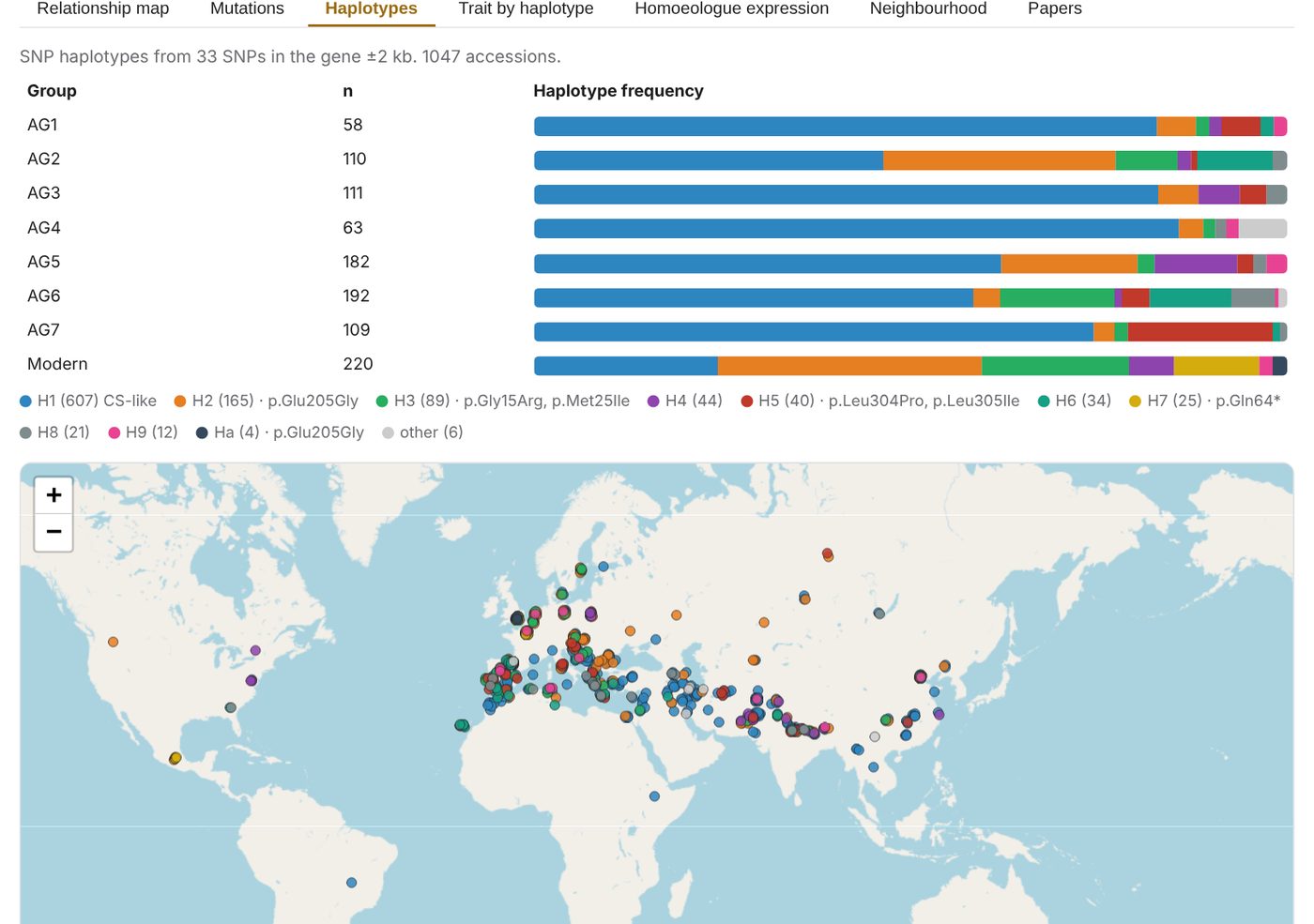 Rht-B1 haplotypes by ancestral group (AG1–AG7, Modern) and on the map; the legend lists coding changes per haplotype.
| Step | What it gives the breeder |
|---|---|
| Haplotypes tab | Allele frequencies by ancestral group; click a map point for the accession and its Seedstor seed link |
| Predicted loss-of-function alleles (same tab) | Each HIGH-impact variant with homozygous and heterozygous carriers by name and group |
| Trait by haplotype | Field-trial values per haplotype in the Watkins trials |
| Mutations tab | EMS lines in Cadenza and Kronos with the same gene disrupted, for a ready-made mutant allele |
Try it
Which Rht-B1 alleles exist in the Watkins collection? List the lines carrying a loss-of-function allele, and compare plant height between haplotypes in the JIC trials.
Tools called: watkins_gene_haplotypes, watkins_lof_alleles, watkins_haplotype_trait (trait "Plant height").
Loss-of-function allele. One variant: 4B:30,861,571 C→T, stop gained, p.Gln64* (Rht-B1b). Homozygous in 25 lines, all in the Modern group, none heterozygous.
| Country | Carriers (selection) |
|---|---|
| Mexico | Pfau, Opata, Waxwing, Super152, Reedling, Weebill 1, MISR1, Cimcog26 |
| France | Soissons, Recital, Cezanne, Courtot, Altria, SY Mattis |
| United Kingdom | Renan, Robigus, Trafalgar, Highbury, KWS Santiago |
| Australia, Canada, USA | LongReach Lancer, CDC Landmark, Jagger |
Height by haplotype (Kruskal–Wallis across haplotypes with ≥ 5 lines):
| Trial | Haplotypes compared | Lines | p | Notable difference |
|---|---|---|---|---|
| JIC H2006 (WGIN) | 8 | 796 | 2.3 × 10⁻⁵ | H5 110.1 cm (n = 39) vs H1 99.4 cm (n = 535) |
| JIC H2020 (DFW) | 6 | 94 | 0.39 | none |
What to take from it. The known semi-dwarfing allele is found automatically, with named carriers, because the tool reads the predicted consequence of each SNP. The landrace trials contain no H7 lines, so they cannot measure the Rht-B1b effect itself; the H5 difference in 2006 is significant but not repeated in 2020 and is uncorrected for ancestry. Follow up with "Which ancestral groups do the H5 lines come from, and how tall are other lines from those groups in 2006?" before believing it. Watkins accessions are ordered from the JIC SeedStor.
2. From a GWAS hit to a gene and a marker (plant height)
The strongest OzWheat plant-height association (Narrabri 2019, p = 7.3 × 10⁻¹⁷) is marker SNP21122_4D at 4D:18,781,242, inside TraesCS4D02G040400, the Rht-D1 gene. askWheat makes that link for every OzWheat association: the marker, its position, the gene it falls in and that gene's page.
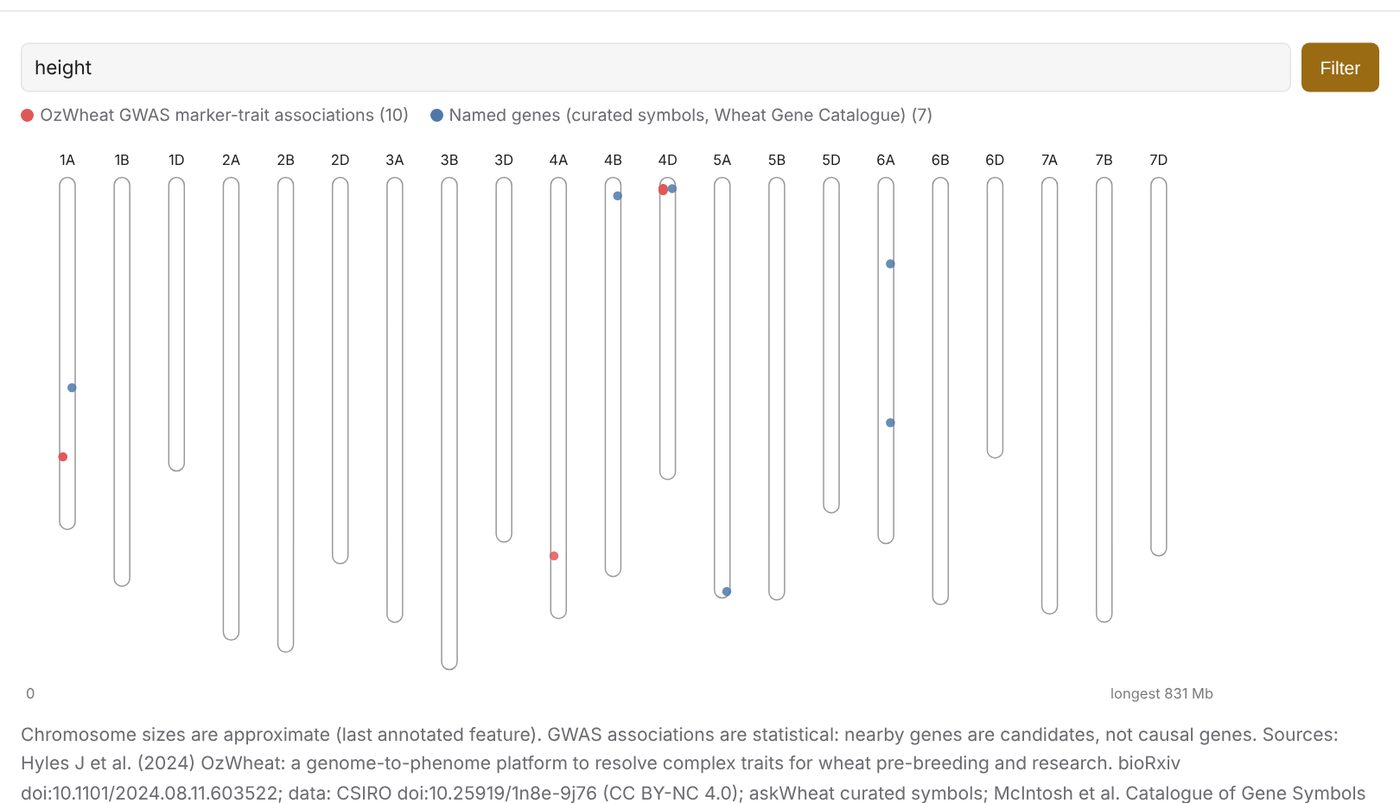 Trait map filtered by "height": OzWheat associations (red) and named genes (blue). The 4D association sits on Rht-D1; Rht-B1 is at the top of 4B.
- Filter the trait map by trait (height, heading, anthesis) and click a point for the association, its trial and p-value.
- Open the gene page to check expression, homoeologues and Watkins haplotypes (example 1).
- Find a marker: for Rht-B1 the CropSNPdb panel has a marker named Rht-B1 at 4B:33,614,738 (RefSeq v2.1) inside the gene.
- Check the region in the genome browser with the OzWheat, named-gene and WatSeq SNP tracks.
Try it
What are the strongest OzWheat associations for plant height? For each, give the gene the marker sits in, the allele effect, and whether it repeats across trials. Show them on the chromosomes.
Tools called: ozwheat_mtas (trait "plant height (cm)"), then trait_hits for the chromosome picture.
| Marker | Position (v1.0) | Trial | p | Gene with the SNP | Allele means (lines) |
|---|---|---|---|---|---|
| SNP21122_4D | 4D:18,781,242 | Narrabri 2019 | 7.3 × 10⁻¹⁷ | TraesCS4D02G040400, Rht-D1 | C 82.5 cm (169) vs G 73.2 cm (86) |
| SNP21122_4D | same | Wagga 2018 | 3.2 × 10⁻¹³ | Rht-D1 | C 79.8 (160) vs G 69.3 (86) |
| SNP21137_4D | 4D:22,018,842 | Wagga 2018 | 1.0 × 10⁻¹⁰ | TraesCS4D02G046500 | C 79.9 (127) vs G 69.5 (67) |
| SNP21137_4D | same | Narrabri 2019 | 4.6 × 10⁻¹⁰ | TraesCS4D02G046500 | C 82.7 (135) vs G 73.7 (67) |
| SNP21122_4D | 4D:18,781,242 | Canberra 2018 | 2.2 × 10⁻⁹ | Rht-D1 | C 65.2 (178) vs G 58.7 (86) |
What to take from it. The same Rht-D1 marker leads in three of the four trials, with a 6–11 cm difference between alleles: a stable, large effect worth selecting on. The second marker, 3.2 Mb away, gives a similar 9–10 cm effect and may be the same signal in linkage with Rht-D1, so check before treating it as a separate gene. For a marker in a gene, ask "Find markers in Rht-B1" (find_marker).
3. Checking parents and pedigrees (Scepter and Mace)
CropSNPdb holds SNP-array genotypes of Australian and international cultivars with their pedigrees, so two parents can be compared before a cross, or a line checked against its recorded parentage. Scepter (AGG 43387; pedigree RAC1480/2*Mace) is 88–99% identical to Mace across the chromosomes tested, as expected for a backcross to Mace; the differing regions are the candidates for segments from RAC1480.
| Chromosome | Markers compared | Identical | Differing regions (RefSeq v2.1, Mb) |
|---|---|---|---|
| 6A | 682 | 88.3% | 30.5–42.0, 52.6–55.2, 459.0–459.5 |
| 7A | 1,334 | 97.8% | 0.6–8.9, 78.3–80.3, 694.7–699.2 |
| 1A | 942 | 98.6% | 586.8–595.6 |
| 5A | 1,121 | 98.6% | 4.3–4.6, 21.2–30.6 |
| 2B | 1,478 | 99.0% | 786.6–795.8 |
| 3B | 1,288 | 99.2% | 23.2–28.3 |
Try it
Step 1, find the lines:
Is Scepter in CropSNPdb? Give its accession and pedigree.
snp_lines returns SCEPTER, AGG 43387 WHEA, Australia, donor Australian Grain Technologies, pedigree RAC1480/2*MACE. Use the CropSNPdb line names (SCEPTER, MACE) in the next steps.
Step 2, compare:
Compare SCEPTER and MACE on 1A, 2B, 3B, 5A, 6A and 7A. Chart percent identity by chromosome and list the differing regions.
snp_compare_lines runs once per chromosome and gives the table above; the assistant turns the identity column into a bar chart. On 4B 20–40 Mb the two lines are identical at all 64 markers compared.
Step 3, test a segment:
Which genebank lines share Scepter's haplotype on 6A between 31 and 36 Mb?
snp_haplotype_carriers result |
Value |
|---|---|
| Accessions tested | 33,032 |
| Informative markers in the window | 9 (MAF ≥ 0.05) |
| Lines matching at all 9 | 6,758 (20%) |
| Tool note | common haplotype, not diagnostic for Scepter at this marker density |
What to take from it. Pedigree checks work well chromosome by chromosome. A haplotype search is only as good as the markers in the window: here Scepter's 6A segment is shared by a fifth of the collection, so it cannot trace Scepter's donor or be selected on. Search a window with more informative markers before drawing conclusions.
4. Resistance genes in germplasm (Lr34/Yr18/Sr57)
resolve_gene turns Lr34 into TraesCS7D02G080300, confirms the ID against the Catalogue of Gene Symbols, and lists its other names (Yr18, Sr57, Pm38, Ltn1) with the cloning paper (Krattinger et al. 2009, doi:10.1126/science.1166453). The Haplotypes tab shows how the Watkins collection splits at the gene.
| Haplotype | Lines | Coding change vs Chinese Spring | Reading |
|---|---|---|---|
| H1 | 786 | p.His633Tyr | susceptible-type residue at the exon 12 diagnostic site |
| H2 | 166 | p.His633Tyr | susceptible-type |
| H3 | 54 | none (Chinese Spring-like) | candidate Lr34res carriers |
| H4 | 36 | p.His633Tyr, p.Pro441Leu | susceptible-type |
Chinese Spring carries the resistant Lr34 allele, which differs from the susceptible one by His/Tyr in exon 12 and a 3 bp deletion in exon 11. Only 54 Watkins lines (about 5%) keep the Chinese Spring residue, so they are the ones worth testing with the diagnostic marker.
Try it
What is Lr34 in the wheat genome, and which Watkins lines are likely to carry the resistant allele? Tell me what the data can and cannot show.
Tools called: resolve_gene, watkins_gene_haplotypes, then find_marker when asked for a marker.
- Gene. TraesCS7D02G080300 (v1.0 TraesCS7D01G080300, v2.1 TraesCS7D03G0183600); synonyms Yr18, Sr57, Pm38, Ltn1; ABC transporter; verification "catalogue". The tool also warns that Ensembl names two other genes "Lr34" (TraesCS7D02G080200 and a 4A gene), which conflict with the curated ID.
- Haplotypes. Four, from 3 SNPs (table above); 54 lines Chinese Spring-like.
- Marker. "Is there a marker called Lr34?" returns nothing. Ask instead for markers near the gene ("CropSNPdb markers within 500 kb of TraesCS7D02G080300"), or use the published diagnostic KASP.
What to take from it. Ask the assistant to state limits, and it will: the SNP-only WatSeq set cannot see the exon 11 deletion, so the 54 lines are candidates to genotype, not confirmed Lr34res carriers. The naming conflict is a common trap with resistance genes; use the IWGSC ID askWheat resolves, not an Ensembl display name.
5. Candidate genes under a QTL (rust resistance on 2B)
A resistance QTL on 2B between 0 and 50 Mb holds hundreds of genes; the gene finder narrows them to the 65 with an NB-ARC domain, the hallmark of NLR resistance genes, each with its position and a genome-browser link. Download TSV takes the list to Excel or R.
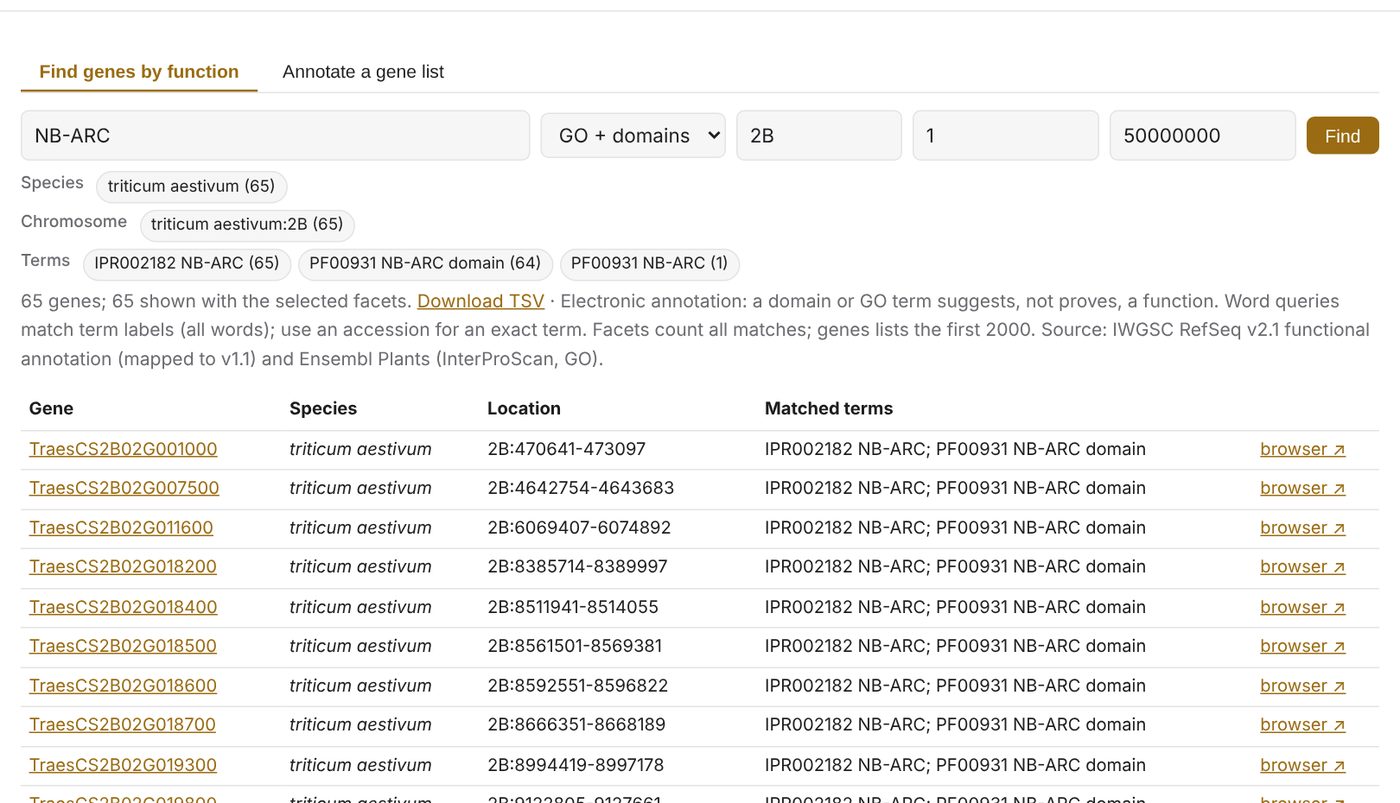 Gene finder for NB-ARC on 2B, 0–50 Mb, with facet chips for species, chromosome and term.
Then rank the candidates: expression in the right tissue (gene expression or the gene-list tab), variation in the Watkins collection (Haplotypes tab, watkins_gene_trait against the 2013 Kenya/Ethiopia and 2020 seedling rust scores), and a conserved neighbourhood in barley, Ae. tauschii and rice (Neighbourhood tab).
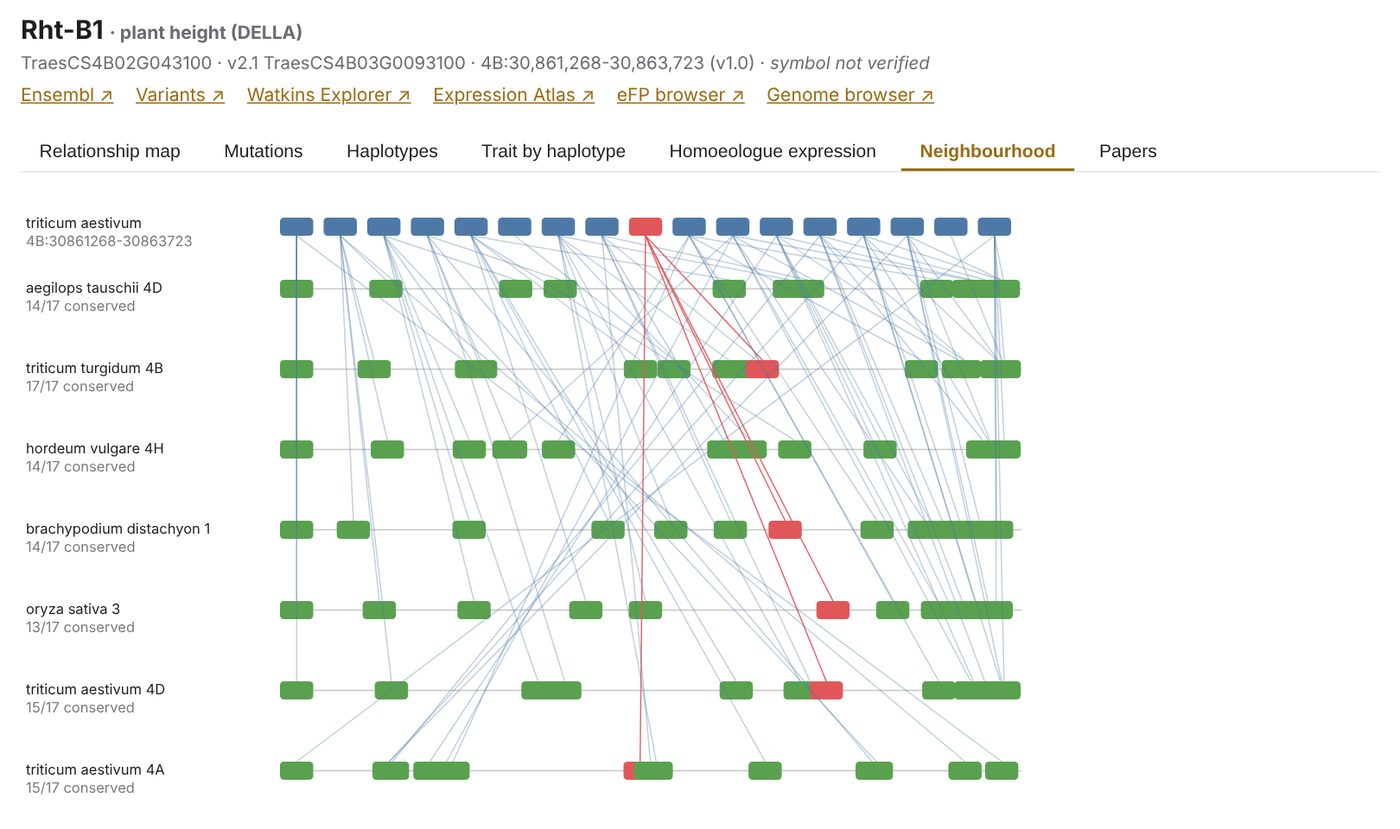 Neighbourhood tab (shown for Rht-B1): 14–17 of 17 neighbours are collinear in Ae. tauschii, durum, barley, Brachypodium and rice.
Try it
Step 1, shortlist by function:
List NB-ARC genes on wheat 2B between 0 and 50 Mb, with positions, as a bar chart per 5 Mb bin.
genes_with_annotation (term "NB-ARC", chromosome 2B, 1–50,000,000) returns 65 genes, all with InterPro IPR002182, first at 2B:470,641 (TraesCS2B02G001000), then a dense group between 8.4 and 9.1 Mb (TraesCS2B02G018200 to TraesCS2B02G019800).
Step 2, check expression:
For the first five, give leaf TPM and any stress response.
| Gene | Highest baseline TPM (tissue, experiment) | Significant change |
|---|---|---|
| TraesCS2B02G001000 | 0.2 (root, E-MTAB-4484); ≤ 0.06 in seedling leaf | none |
| TraesCS2B02G018200 | 0.18 (seedling leaf control, SRP045409) | down 3.4 log2 after 6 h heat (padj 0.02) |
Step 3, place a published sequence:
Here is the sequence of the KASP flanking region from the paper: which gene and position does it hit? [paste sequence]
blast_sequence chooses blastn (blastn-short under 50 nt) against the RefSeq v1.0 genome and v1.1 CDS. A 600 bp Rht-B1 CDS fragment returned TraesCS4B02G043100 at 100% identity, plus the 4D and 4A homoeologues at 93%, in about 6 seconds.
What to take from it. NLRs are barely expressed in unchallenged tissue, so absence of atlas expression is weak evidence against them. A homoeologue hit at 93% is the reason to design assays on sub-genome-specific SNPs. Domain annotation is electronic: it shortlists genes, it does not prove function.
6. Knockout lines to test a gene
The knockout screen takes a gene list and shows, for every homoeologue, how many Cadenza (hexaploid) and Kronos (tetraploid) EMS lines carry a truncating mutation. All three example genes have truncating lines in every copy, so a full knockout can be stacked by crossing.
| Gene | Copy | Truncating lines | Cadenza | Kronos |
|---|---|---|---|---|
| Rht-B1 | 4A | 4 | 4 | 0 |
| Rht-B1 | 4B | 7 | 5 | 2 |
| Rht-B1 | 4D | 5 | 5 | 0 |
| TaGW2 | 6A | 2 | 0 | 2 |
| TaGW2 | 6B | 5 | 3 | 2 |
| TaGW2 | 6D | 5 | 5 | 0 |
| Lr34 | 7D | 11 | 11 | 0 |
| Lr34 | 4A homologue | 10 | 4 | 6 |
Try it
Can I knock out Rht-B1, TaGW2 and Lr34 in all copies with EMS lines? Give the lines per copy, say which are Cadenza and which Kronos, and give me the knockout-screen link.
Tools called: wheat_knockout_screen, then wheat_mutant_line for one line.
The screen returns status all_copies for all three genes, the lines per copy (e.g. Rht-B1 4A: Cadenza0350, Cadenza1026, Cadenza1237, Cadenza1779) and a link to the same screen on the web, ready for ordering. "How many other mutations does Cadenza1026 carry?" returns 4,816 mutations in 5,270 genes, including 64 stop-gained and 35 splice-site changes.
What to take from it. Kronos is tetraploid, so D-genome copies need Cadenza lines; the tool flags lines that hit two copies at once. For a QTL, give a region instead of genes (up to 10 Mb). Every EMS line carries thousands of background mutations, so plan backcrosses.
Prompts for an AI assistant, with visualisations
| Goal | Prompt | Picture you get |
|---|---|---|
| Donor search | Which Watkins landraces carry a non-Chinese Spring Ppd-D1 haplotype? Map them by country and list Seedstor links. | World map coloured by haplotype |
| Allele effect | Plot heading date by Rht-B1 haplotype in each JIC trial, with group sizes. | Box plot per haplotype and trial |
| GWAS follow-up | List OzWheat plant-height associations, the gene each marker falls in, and show them on the chromosomes. | Chromosome ideogram with hits |
| Parent check | Compare SCEPTER and MACE on every chromosome and chart percent identity. | Bar chart by chromosome |
| Candidate genes | NB-ARC genes on 2B 0–50 Mb: which are expressed in leaf above 10 TPM? Bar chart by 5 Mb bin. | Gene-density bars |
| Homoeologue balance | Show the A, B and D expression of TaGW2 across tissues. | Stacked bars per tissue |
| Knockouts | For these 12 grain-size genes, which have truncating EMS lines in all copies? Heatmap of lines per copy. | Gene × copy heatmap |
| Literature | Papers that mention the IWGSC IDs of Lr34, with DOIs; flag those that only match the name. | Table of papers |
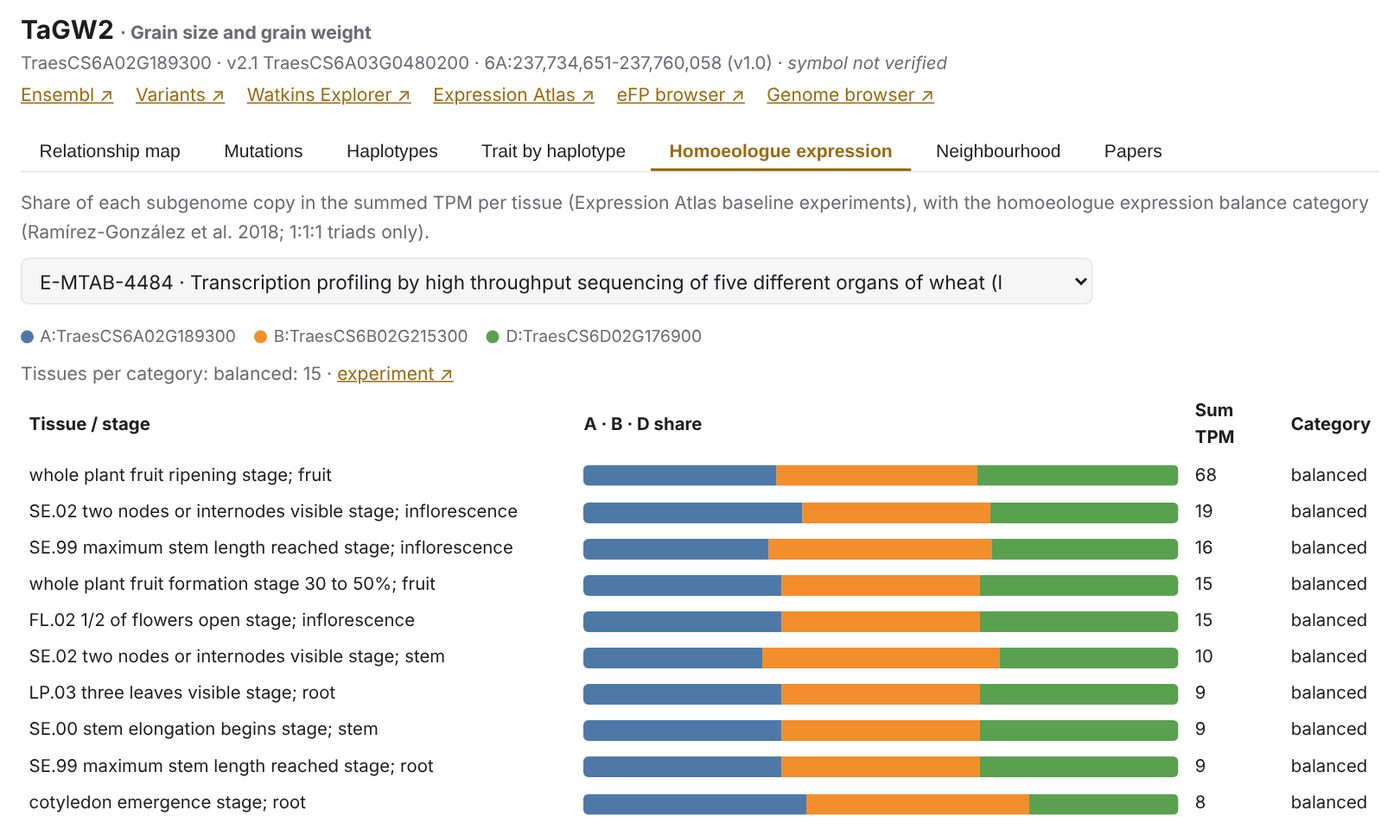 Homoeologue expression of TaGW2: the three copies are balanced in all 15 tissues of E-MTAB-4484.
Writing prompts that work
| Instead of | Ask | Why |
|---|---|---|
| Tell me about Ppd-D1 | Ppd-D1 haplotypes in Watkins: lines per haplotype, coding changes, ancestral groups | Names the dataset and the numbers (answer: 2 haplotypes from 86 SNPs, H2 in 32 lines) |
| Is this gene important for height? | Plot plant height by haplotype of this gene in each JIC trial, with n per box and the test | Gets per-trial evidence, not a judgement |
| Find resistance genes | NB-ARC genes on 2B 0–50 Mb, then their leaf expression | A region and a domain give a list to act on |
| Compare these varieties | Compare SCEPTER and MACE on each chromosome; chart % identity | Uses CropSNPdb names, asks for a picture |
Good habits: give the trial, trait or region when you know it; ask for group sizes with any comparison; ask what the data cannot show; and check a surprising number by opening the source link the answer gives.
Before acting on a result
- Positions are RefSeq v1.0 for genes, WatSeq, OzWheat and JBrowse, but RefSeq v2.1 for CropSNPdb markers; askWheat converts gene IDs between versions, not marker coordinates.
- WatSeq is MAF-filtered and SNP-only: rare alleles and indels (e.g. the Lr34 exon 11 deletion, promoter deletions) are missing.
- Haplotype–trait and presence–trait tests are exploratory, uncorrected for population structure and multiple testing; compare values only within a trial.
- A GWAS marker or NLR domain in a gene makes it a candidate, not the cause.
- Symbols marked "not verified" or "AUTO candidate" need checking against the original paper.
Results shown were produced with askCrop tools in November 2026; numbers change as source databases update.